
Coffee County Arrest Records and Charges
Coffee County arrest records document the arrest or booking event, while court charge records document the formal offenses filed after that event. The booking side may involve the Coffee County Sheriff's Office, the Coffee County Pre-Trial Detention Center, the arresting agency, custody status, and jail records. The court-charge side begins when the case moves into the judicial channel. Magistrate Court handles warrants, first appearances, and preliminary criminal functions. State Court handles many misdemeanor and traffic cases. Superior Court handles felony criminal cases. Douglas Municipal Court handles city ordinance and city traffic matters.
Do not merge booking status with court outcome. A person may be arrested and later have charges amended, reduced, dismissed, nolle prossed, dead-docketed, or resolved by plea or trial. For jail custody and the app-only inmate search, use the jail and Coffee County inmate records channels. For the full criminal case file, including pleas, motions, disposition, and sentencing, use Coffee County criminal court records. Court charges after arrest sit between those two points: they show what was formally filed and how each count currently stands.
Find Coffee County Arrest Records and Charges
The official web research did not locate a public Coffee County mugshot or booking database. The sheriff's public pages route local inmate search to the Coffee County Sheriff, GA mobile app, while sheriff records requests use Coffee County's NextRequest portal when the request is a sheriff agency record. Court charge records are searched through the court side: Georgia provider portals, the Clerk of Superior Court, State Court, Magistrate Court, and Douglas Municipal Court depending on the charge source.
- For current custody, check the Sheriff's Office app or call the jail before assuming a person is still detained.
- For new warrants or first appearances, check Magistrate Court and the Sheriff's Office channels.
- For filed charges, search court access by defendant name or case number through the Georgia provider route.
- Open the case and read each charge, count, severity, filing document, bond action, and current status.
- Request certified dispositions or final charge outcomes from the Clerk of Superior Court when proof is needed.
The Coffee County Magistrate Court page is a key arrest-to-charge source because that court handles warrants, first appearances, and preliminary criminal functions.
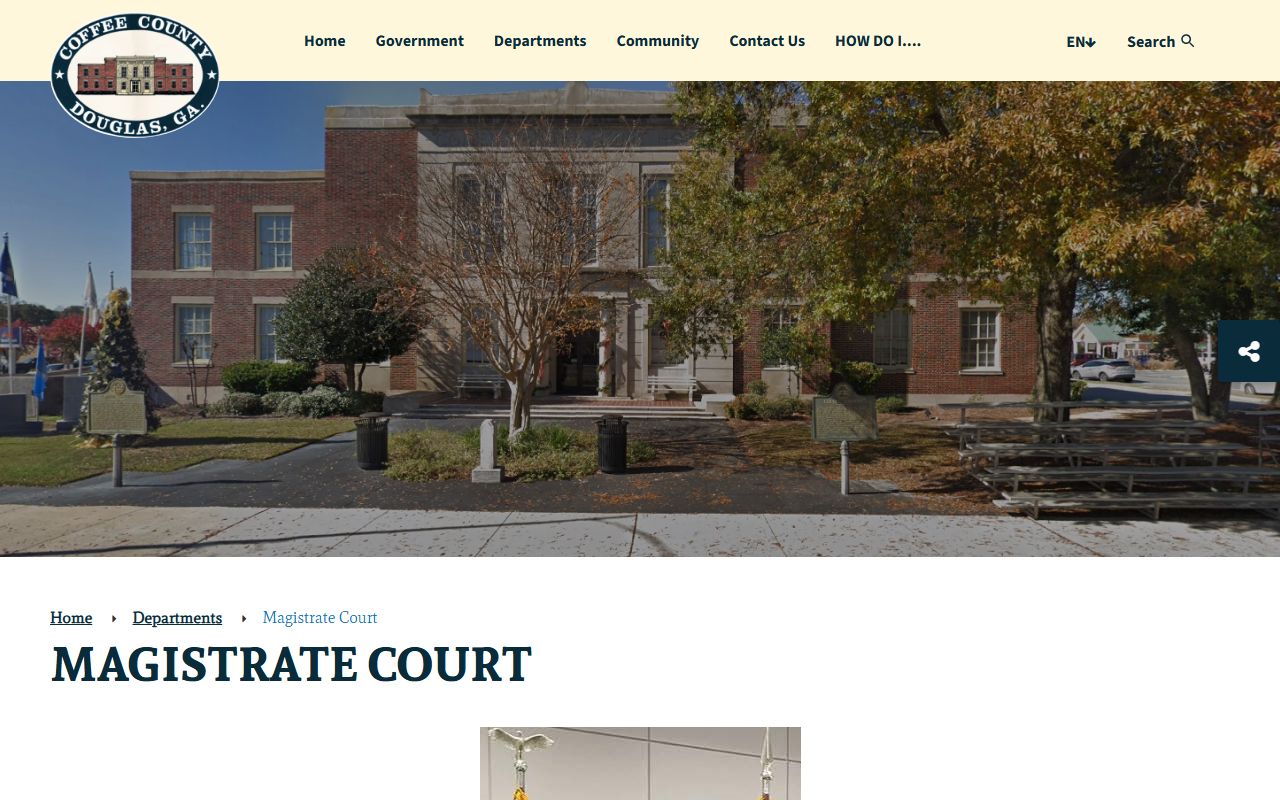
Magistrate Court is often the first court contact after arrest, even when the final filed case belongs in State Court or Superior Court.
Charges After Arrest in Coffee County
Formal charges after arrest can appear in several document types. A complaint may start a criminal matter or support a warrant process. An accusation is a prosecutor-filed charging document, commonly used for misdemeanors and some non-indicted cases in Georgia. An indictment is a grand-jury charging document, most important for felony prosecution. A citation can also start a traffic or municipal case. The charge record may include charge description, statute, count number, offense date, arresting agency, warrant number, case number, bond entry, prosecutor action, plea, disposition, and sentence.
| Complaint | Accusation | Indictment | |
|---|---|---|---|
| Filed By | Officer, complainant, or prosecutor depending on context. | Prosecutor. | Grand jury. |
| Common For | Warrants, early criminal process, or lower-court matters. | Misdemeanors and some non-indicted Georgia cases. | Felony prosecution and serious criminal cases. |
| Coffee County Path | Often tied to Magistrate Court or preliminary process. | Often tied to State Court or prosecutor-filed case records. | Superior Court felony case record. |
| What to Check | Warrant, first appearance, bond, and case number. | Charge count, offense, plea, and disposition. | Count list, felony level, arraignment, trial or plea, and sentence. |
The Magistrate Court general information page confirms the Thompson Drive court location and contact path.
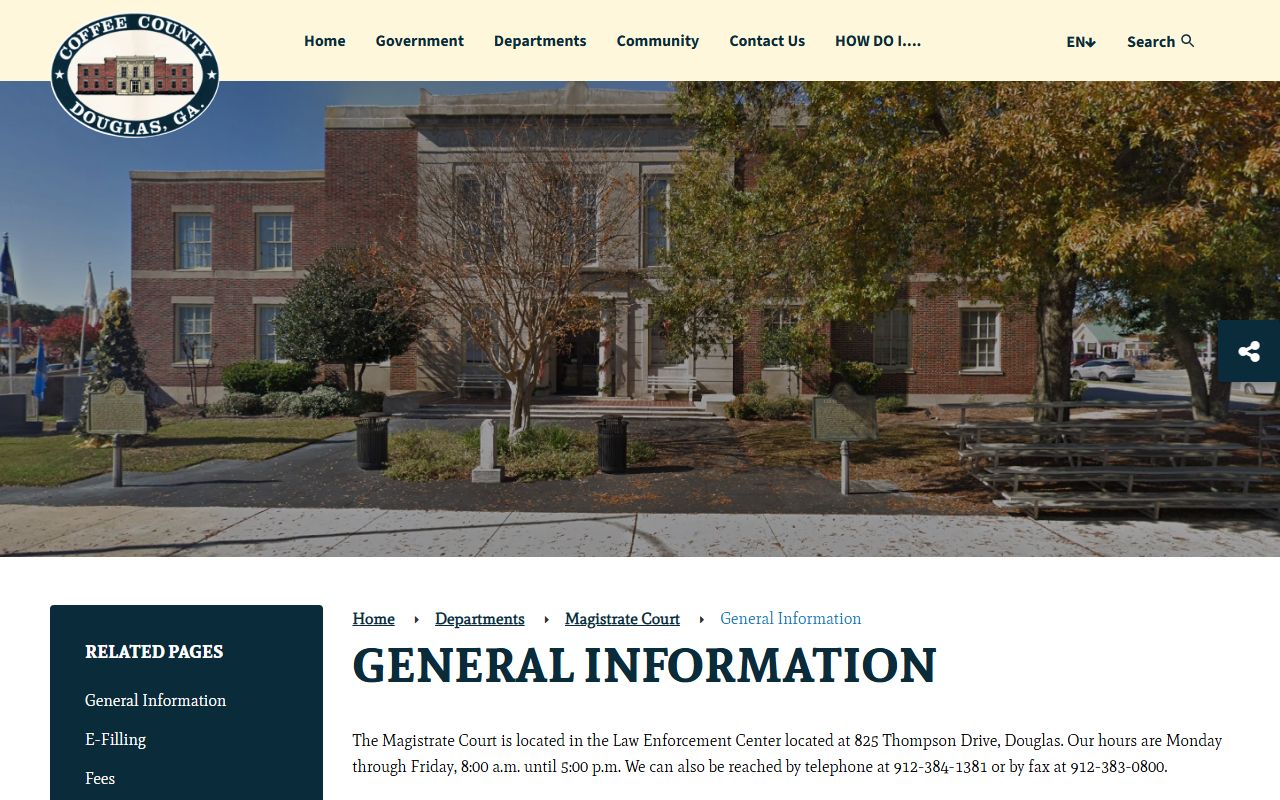
That location matters because the Law Enforcement Center is also central to jail, sheriff, warrant, and Municipal Court appearance activity.
Coffee County Charge Status
Charge status can change as a Coffee County case moves. A charge may begin as pending, then be amended, reduced, dismissed, dead-docketed, nolle prossed, or resolved by plea or trial. Each count should be read separately. One case can contain a felony count, a misdemeanor count, a dismissed count, and a guilty plea to a reduced charge. The public search result may show the charge history, but the current disposition is the part that should be verified before drawing a conclusion.
| Status | What It Means |
|---|---|
| Pending | The charge has been filed and has not reached final disposition. |
| Amended / Reduced | The prosecutor or court changed the charge, often through negotiation, correction, or plea terms. |
| Dismissed | The count or case was ended without a conviction on that charge. |
| Nolle prosequi | The prosecutor chose not to pursue the charge further at that time. |
| Dead docket | A Georgia inactive status showing the prosecution is not currently moving forward. |
| Convicted | A guilty plea, nolo plea treated by the court, or verdict created a conviction record. |
Note: A dismissed Coffee County charge can still require record-restriction work before it is limited in criminal-history systems.
Who Files Coffee County Charges
Felony prosecution in Coffee County belongs to the Waycross Judicial Circuit district attorney. The research identifies Marilyn Bennett as District Attorney through the Prosecuting Attorneys' Council listing, with the Waycross office listed at 306 Albany Avenue, Waycross, Georgia 31501, phone 912-490-4395. State Court misdemeanor and traffic prosecutions connect to the Coffee County State Court Solicitor-General's Office. The county State Court page lists Jared Roberts as Solicitor-General, Kelsi Mizell as administrative assistant, the courthouse address, phone 912-384-8612, and fax 912-383-9088.
State Court Solicitor-General
101 S. Peterson Ave
Douglas, GA 31533
912-384-8612
Handles State Court misdemeanor and traffic prosecution matters.
Waycross Judicial Circuit District Attorney
306 Albany Avenue
Waycross, GA 31501
912-490-4395
Handles Superior Court felony prosecution for the circuit.
Coffee County Charges vs Convictions
A charge is not a conviction. Coffee County arrest records and court charge records may show accusations that were later dismissed, reduced, or not pursued. A conviction appears only after a guilty plea, nolo plea accepted by the court in a way that creates a conviction result, or trial verdict. This difference matters for employment questions, licensing questions, landlord screening, personal safety decisions, and record restriction. Always read the disposition field instead of stopping at the first charge name.
| Charge | Conviction | |
|---|---|---|
| Meaning | A formal accusation or count filed after arrest. | A court result establishing guilt. |
| Where it appears | Booking context, warrant records, court docket, accusation, indictment, or citation. | Disposition, plea entry, verdict, sentencing order, or certified disposition. |
| Can change | Yes, it may be amended, reduced, dismissed, or nolle prossed. | Yes, but changes require court action, appeal, restriction, or other legal process. |
| Best proof | Current court docket and filed charge document. | Certified disposition or sentencing order from the clerk. |
Coffee County Charge Fields
Charge entries in a Coffee County criminal case can include the charge description, Georgia statute, count number, offense date, arresting agency, warrant number, case number, prosecutor action, bond status, plea, disposition, and sentence. Severity matters. Felony charges route to Superior Court. Misdemeanor and traffic charges often route to State Court or Municipal Court. Some early warrant or first-appearance activity routes through Magistrate Court. One arrest can lead to several counts, and each count can have its own result.
The Coffee County Magistrate Court forms page lists practical form families such as criminal, civil, garnishment, dispossessory, consent judgment, FIFA request, default affidavits, and deposit-account fraud forms.
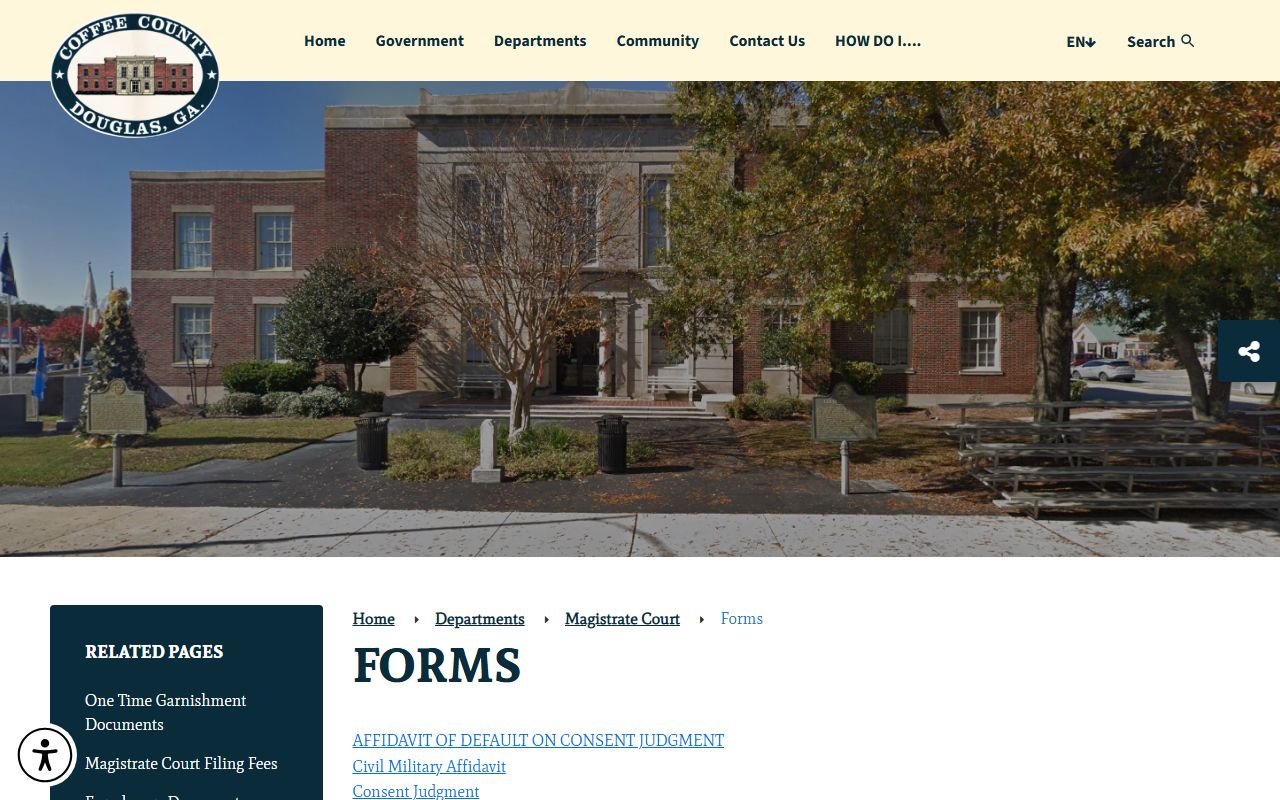
Those forms show why Magistrate Court records can involve both criminal startup points and lower-court civil records that should not be confused with charges.
Statewide Charge and History Limits
Georgia statewide criminal-history access is not the same as a Coffee County court charge lookup. Court records show what was filed and how the case moved through court. Criminal-history records can include arresting-agency and state repository information, and restriction is controlled by O.C.G.A. 35-3-37. The research says GBI guidance requires prosecutor contact for arrests after July 1, 2013 and arresting-agency application for older arrests. A dismissed or nonconviction court result may still need a separate restriction process before public criminal-history access changes.
Note: For official proof of a Coffee County charge outcome, request a certified disposition from the clerk.
Coffee County Charge Record Costs
The research did not locate a Coffee County certified-copy fee schedule for criminal charge records. It did locate a Magistrate Court filing-fee page and fee PDF link, and Georgia's Open Records Act allows copying and search or retrieval charges as provided by law. Because court-copy fees can vary by document, certification, and office, the safest path is to ask the Clerk of Superior Court or the court that owns the record before mailing a request or relying on online provider costs.
The Magistrate Court fees page is the assigned fee-source screenshot for this arrest-to-charge topic.
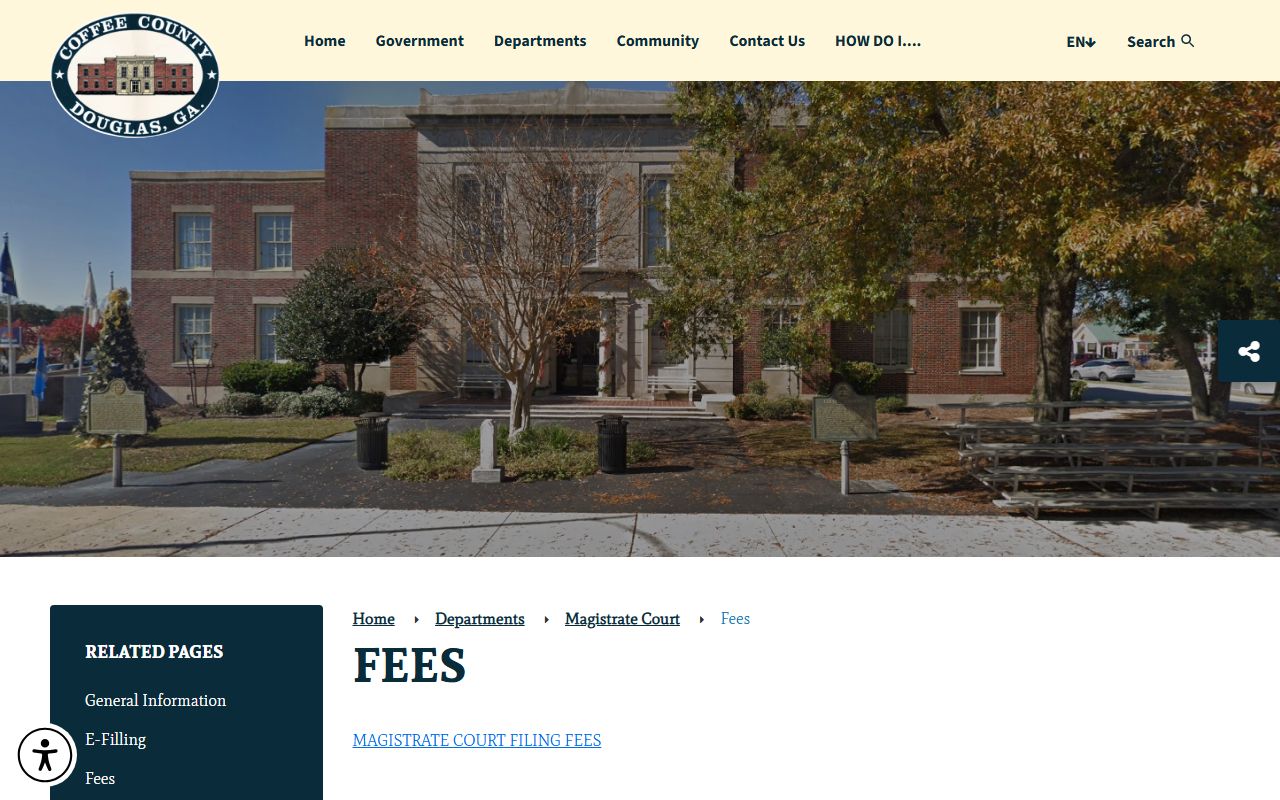
Use the fee page for Magistrate Court filing context, not as proof of a certified criminal disposition cost from the Superior Court clerk.
Restricted Coffee County Arrest Records
Arrest records, charge records, and criminal case records can all be restricted in different ways. Juvenile law limits access to juvenile files, and law-enforcement juvenile records must be kept separate from adult arrest files. A judge can seal a court file under the proper rule or law. Protected identifiers, medical data, minors' names, Social Security numbers, financial account numbers, and some safety-sensitive information can be redacted. Search warrants may stay sealed during an active investigation. Adoption and mental-health related matters should be treated as confidential unless a court-authorized path applies.
Georgia record restriction can limit qualifying criminal-history records, but it is not automatic proof that every docket entry, agency record, or charge reference is gone. For post-July 1, 2013 arrests, the research points to prosecutor contact. Superior Court felony charges connect to the Waycross Judicial Circuit district attorney. State Court misdemeanor and traffic charges connect to the solicitor-general. If restriction is granted, jail or law-enforcement agencies may need matching notice or request before agency records are restricted.
Important: Do not use an arrest entry alone as proof that a Coffee County charge ended in conviction.